

Recladding is increasingly emerging as a circular alternative to the old reflex of demolition and rebuild. Instead of scrapping entire structures, project teams keep what works and radically upgrade the envelope. This shift to high‑rise façade renewal saves embodied carbon, reduces disruption, and often shortens project timelines. At Facade Today, this evolution resonates strongly with our editorial line. We consistently highlight façades as strategic drivers of sustainable transformation. This circular shift puts the envelope exactly where we like to see it: at the heart of design decisions, not as an afterthought.
Through recladding, designers can cut energy demand, improve comfort, and refresh the architectural image in one move. Moreover, a well‑designed new envelope can extend the service life of an existing building by decades. It can also reposition the asset in a changing market. In short, “reduce, reuse, reclad” turns façade design into one of the most powerful drivers of circular transformation.
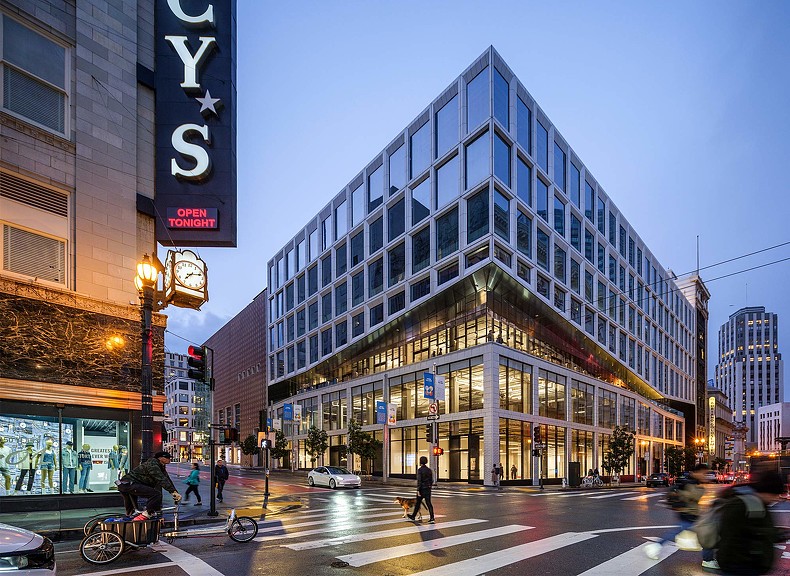
Architects: Gensler
Engineering: Degenkolb and KPFF
Image: Courtesy of Gensler
Obsolescence Rewritten
Façades without Expiry Dates
The circular economy is a way of designing and managing buildings. It keeps materials in use for as long as possible, at their highest value. Instead of the classic “take–make–dispose” model, it promotes “reduce–reuse–recycle”. The focus is on extending the life of what already exists. Applied to façades, this means seeing existing envelopes and structures as assets, not waste. The benefit is double. You limit the extraction of new resources, and you preserve the carbon, energy, and effort already invested in the built fabric. At the same time, you keep buildings adaptable. They can evolve with new uses and expectations instead of being replaced too early.
Obsolescence is the opposite movement: it is what happens when a façade is treated as a disposable object, designed for one cycle and then discarded. Sometimes this obsolescence is technical or regulatory, but it can also be purely aesthetic or market‑driven.
A circular approach such as high‑rise façade renewal tries to slow down and reorganise this process. It asks how to reconnect façades to a material loop, where components can be maintained, upgraded, reused, or recycled. The aim is to avoid sending them straight to landfill. In that perspective, each recladding project is an opportunity to correct past “linear” choices. It also helps prepare the next life of the envelope.
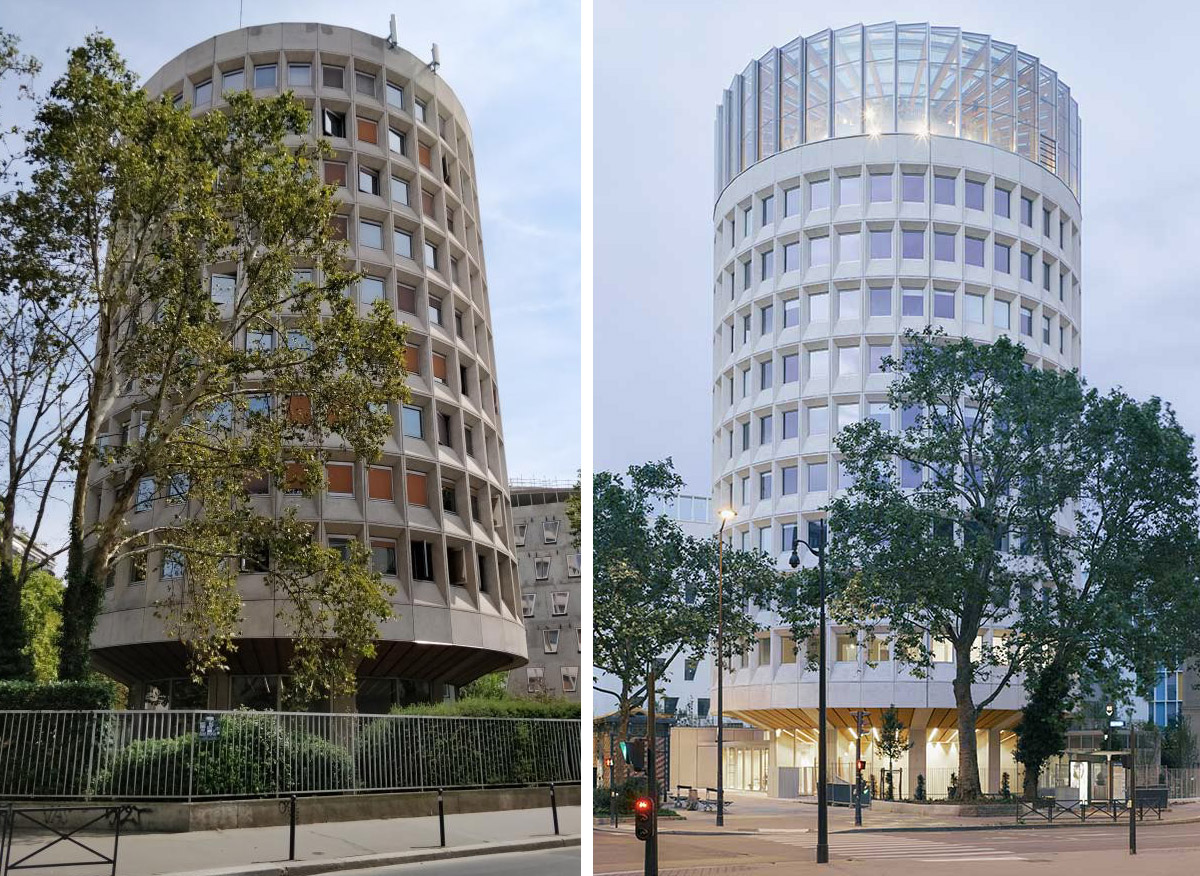
Architects: Maud Caubet Architectes
(Facade) engineering & consulting: Arcora and CSD Faces
Photo: Fabrice-Fouillet
Mapping the Existing Skin
Data‑Driven Decisions for High‑Rise Façade Renewal
Circular recladding starts with one simple principle. You cannot design the new skin if you don’t really know the old one. A circular approach is not just a new façade hung on an old frame. It is a design and engineering process rooted in careful diagnostics, measured data, and honest constraints.
From Diagnostics to Design Decisions
First, assessing the existing façade is crucial. Teams combine specialist condition surveys, drone or rope‑access inspections, and targeted intrusive openings. Firms like Eckersley O’Callaghan 1 and WSP 2 use staged surveys: an initial high‑level scan. Then they carry out close‑up and intrusive checks to understand fixings, joints, hidden corrosion, and water paths. This is often supported by infrared thermography, moisture measurements, and on‑site pull‑out tests. Where reuse of glass is considered, aged units are lab‑tested for strength, coatings, and seal durability.
Then comes the big question: what do we reuse, and what do we replace? Here, decision matrices and “retrofit typologies” are very useful. Research on façade retrofitting distinguishes between component replacement, full reclad, and overclad solutions. It links each typology to drivers such as energy performance, failures, code compliance, or change of use. In practice, engineers like Arup 3 build simple but robust matrices scoring each element (structure, sub‑frame, cladding, glazing) against criteria such as capacity, remaining service life, embodied‑carbon savings, and cost. These matrices justify a reuse‑or‑replace decision in front of the client.
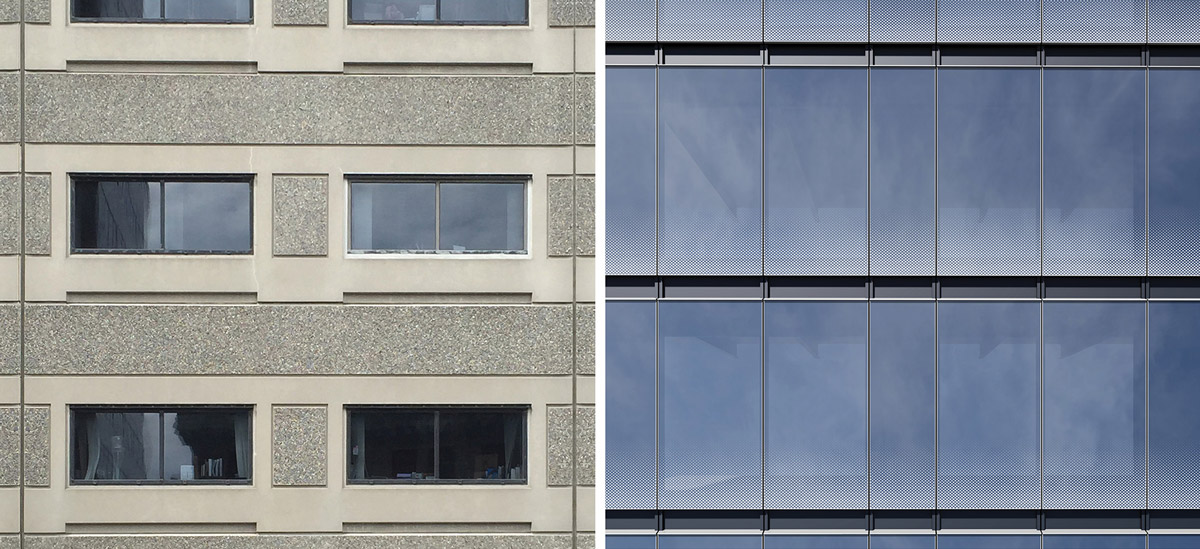
Architects and Façade Engineering: Gensler
Photos: Courtesy of Gensler
Transforming the façade
Interfaces, tolerances, and structural constraints quickly turn these decisions into hard reality. Existing slabs are rarely perfectly level. Old anchors are not always where you wish they were. Designers must negotiate offset loads, bracket geometry, and movement joints, while still keeping buildability and disassembly in mind. Circular thinking pushes us to favour adjustable, demountable systems and to document them with clear 3D models, connection schedules, and “design‑for‑disassembly” checklists. This is explored in recent façade‑component research at TU Delft and ETH Zurich.
Phasing Works Around Tenants and Daily Life
Finally, most reclads happen with tenants still inside. Managing works on occupied buildings adds another layer: phasing, swing‑spaces, noise, dust, and safety for occupants. Companies like Gensler and WSP use phasing diagrams, mock‑ups, and test bays to sequence removal and installation by zone. They often rely on night or weekend shifts to keep interiors operational. Clear communication with occupants and building management becomes part of the façade strategy. In the end, circular recladding is as much about people and process as it is about panels and performance.
(1) Rethinking the Need for New Buildings, Eckersley O’Callaghan, 2024
(2) Refurbishment and Retrofit, WSP
(3) What reclaiming façade materials teaches us about sustainable buildings, Arup, 2024
Demolish or Transform?
The Numbers Decide
Deep high‑rise façade renewal is often framed as a cost or compromise. In reality, it can be a financial lever 1. In New York, recladding and deep retrofit of an office building can sit around 150–250 USD per square foot. Demolition plus full new build frequently reaches 300–400 USD per square foot or more.
Recent data from London show deep retrofit, including facade replacement and systems upgrades, in the range of 113–268 GBP per square foot. New Grade A construction typically commands significantly higher capital costs and prime rents.
Across dense Asian markets such as Hong Kong, façade renovation often falls in the order of 350–1,500+ USD per square metre, depending on system complexity. Full redevelopment can exceed these figures once demolition, structure, and fit‑out are included. By contrast, keeping the frame and recladding the envelope concentrates budget where it has most impact. It targets energy use, comfort, daylight, and market image.
Economic arguments do not stand alone.
Planning rules and building codes increasingly point in the same direction. Many cities now promote refurbishment over demolition through faster permitting, heritage safeguards, or embodied‑carbon targets 2. Energy codes push owners to upgrade thermal performance and airtightness when they touch the facade. Incentives, such as tax advantages or grants for energy renovations, can further tip the balance. They often favour deep retrofit. For design teams, this regulatory landscape is not just a constraint. It is a strategic context.
Of course, owners worry about risk, warranties, and long‑term value. Will a reclad building attract similar rents as a new one? Will insurers and lenders treat it as a “second‑best” asset? The answer depends on execution. A well‑engineered reclad, with clear warranties on new systems and documented performance, can reposition an asset. The effect can last for decades. In some markets, it even becomes a signal: this owner takes carbon, cost, and resilience seriously.
(1) EPC B Retrofit London 2026: The £150/sq ft Viability Trap and the Rise of Stranded Office Assets
Hong-Kong Report – Quarterly Construction Cost Update, Rider Levett Bucknall, 2021
Is a refurbished office space more cost-effective than new construction?
The Rise of Office Retrofits: Why London’s Square Mile is Leading the Way
(2) For example: City of London (as distinct local authority), Amsterdam, Paris, Berlin, Madrid, Rome, Portland (Oregon), Palo Alto, New York City, Westminster (London borough), Manchester, Dublin, Singapore, Braga, and many more.
Giving Existing Envelopes a Second Life
The Next Big Leap for the Façade Community
Façade obsolescence needs a rethink. Instead of treating aging envelopes as waste, “reduce, reuse, reclad” frames them as assets in transition. Envelopes become layers we upgrade, not shells we discard.
At project level, this shift unlocks new options. Designers, engineers, and owners can combine structural reuse, targeted recladding, and smarter detailing to cut carbon. At the same time, they improve comfort and performance. It is less glamorous than a ground‑up icon, but often far more impactful.
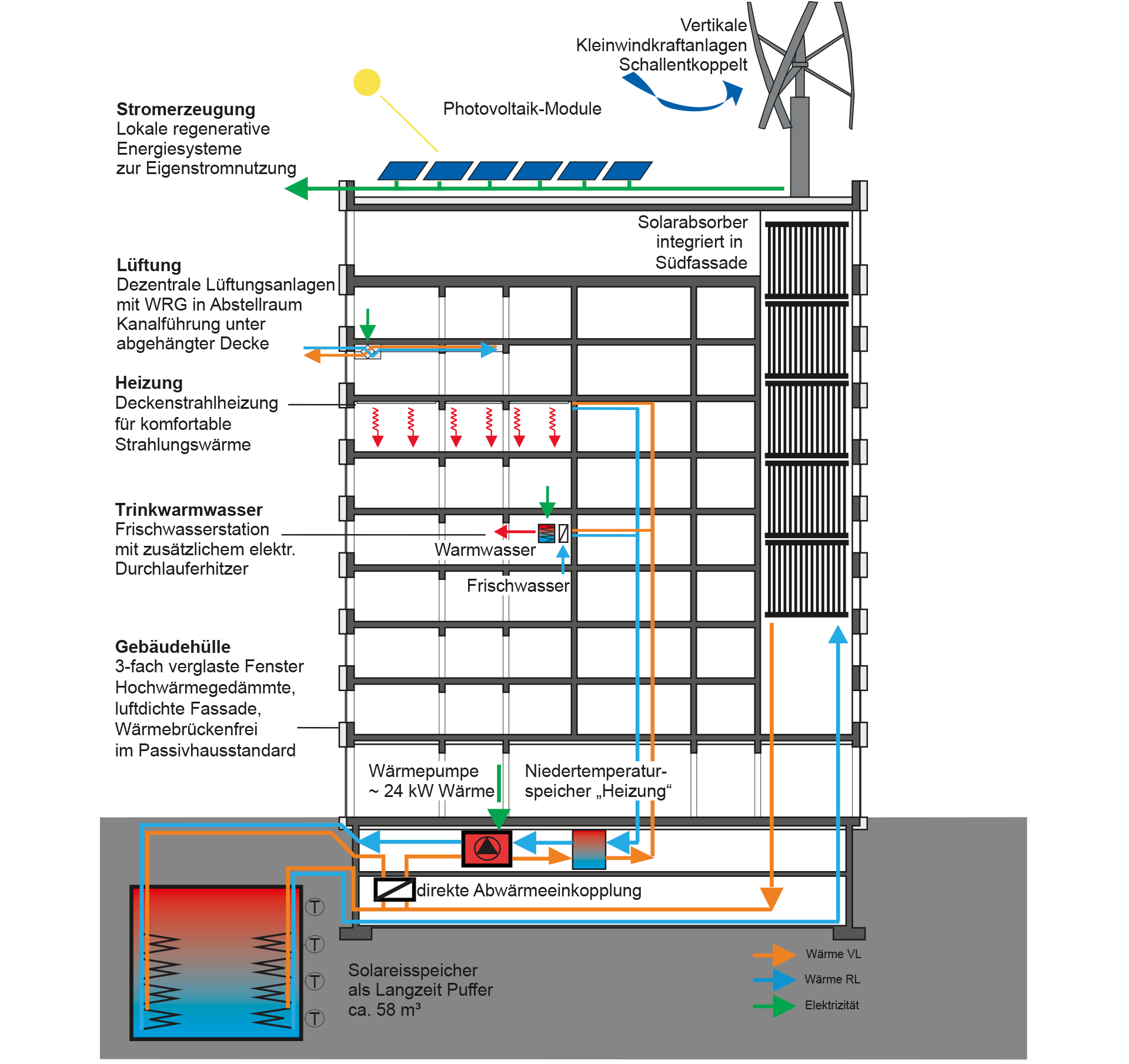
Architect Freivogel Architekten
KlimaEngineering: Transsolar & partners
At city scale, the potential is huge. Systematic facade renewal can decarbonise existing stocks and refresh urban identities. It can also extend building life by decades. Here, public authorities are pivotal. They can tighten climate and performance standards while fast‑tracking permits for deep retrofit. They can also adjust taxes and subsidies to favour reuse over demolition and integrate facade renewal into long‑term urban and housing policies. Their choices set the frame in which projects become possible. But responsibility does not stop there. The entire building sector, clients, architects, engineers, manufacturers, contractors, shares ownership of this shift. No single actor can deliver it alone.
Useful links
Redefining façade renovation studies: ten building blocks from ten case studies to reuse façade products, by Ruben Van Vooren, Esther Geboes, Waldo Galle, in Frontiers in Built Environment, 2026
A conceptual design of circular adaptive façade module for reuse, by Dalia Niazy, Esraa A Metwally, Mostafa Rifat, Mohammed Ibrahim Awad, Ahmed Elsabbagh, Nature.Com
Re-Glaze | Condition assessment and design strategies for reuse of façade glass and glazing products, Dr. Vlad Silvestru, ETH Zürich
Case studies
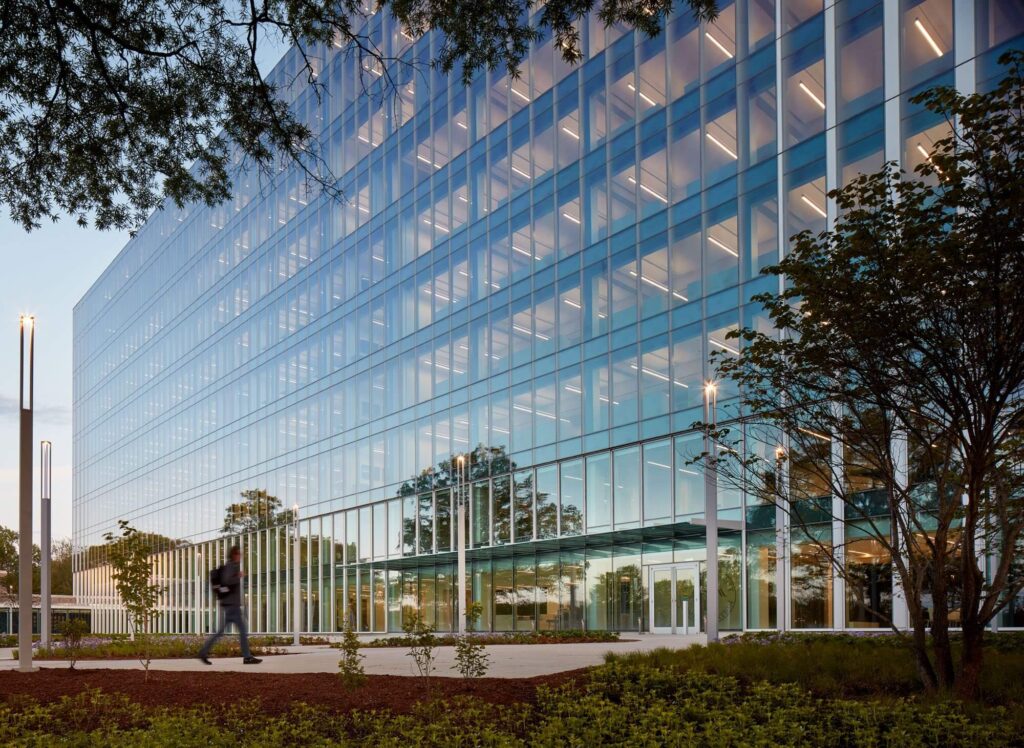
The Arthur J. Altmeyer Social Security Building, Woodlawn, MA, USA
Architects: Snow Kreilich Architects and Studio NYL
Facade engineering: WDP and Studio NYL
Photo: Courtesy of Snow Kreilich Architects
The Arthur J. Altmeyer Social Security Building in Woodlawn, Maryland, shows how a mid‑century federal block can be radically renewed through a reduce, reuse, reclad strategy rather than replacement. Originally completed in 1959, the 10‑storey concrete frame was retained. Snow Kreilich Architects and Studio NYL led the design of a new high‑performance unitized anodized‑aluminium curtain wall with low‑e insulated and fritted glazing tuned by orientation to control solar gain and glare. HGA served as architect of record and engineering lead, with WDP providing building enclosure commissioning. Studio NYL acting as façade engineering specialist.
Energy modelling drove the envelope and MEP design toward a façade with roughly 39% overall glazing, VAV systems with energy recovery, and an envelope that outperforms ASHRAE baseline values by about 14.8%. This results in delivering approximately 16.3% energy‑cost savings and 21.2% site‑energy savings. Completed around 2021 and certified LEED Silver, the project also cut embodied carbon and saved an estimated 13 million USD by reusing the structure.
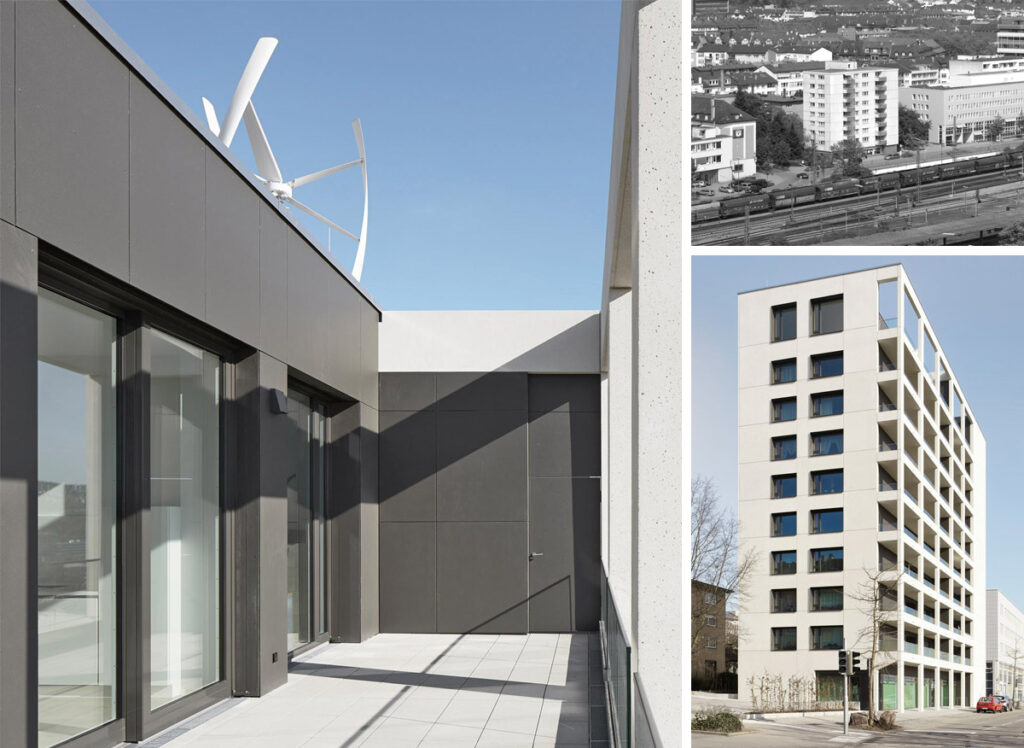
Güterstrasse 30, Stuttgart, Germany
Architects: Freivogel Mayer Architekten
KlimaEngineering: Transsolar & Partners
Photos: Dietmar Strauss
Freivogel Architekten and Transsolar‘s refurbishment of the nine‑storey residential tower at Güterstrasse 30 in Stuttgart turns a 1970s high‑rise into an almost zero‑carbon building without demolition. The existing structure and apartments were retained while tenants remained in place. A new highly insulated, ventilated building envelope brought the façade up to German Passive House standard, dramatically improving thermal, acoustic and solar comfort.
Central to the concept is a combustion‑free HVAC system. Façade‑integrated capillary solar absorbers and a heat pump connected to an ice‑storage system provide heating and domestic hot water. They are complemented by decentralized mechanical ventilation with heat recovery. Photovoltaic panels and a vertical wind turbine on the roof generate renewable electricity, with surplus power fed into the grid. Post‑completion monitoring confirmed that the building meets predicted performance. It is cutting operational carbon emissions by around 95% compared to the unrefurbished state. The project was completed mid‑2010s and has received multiple sustainability awards.
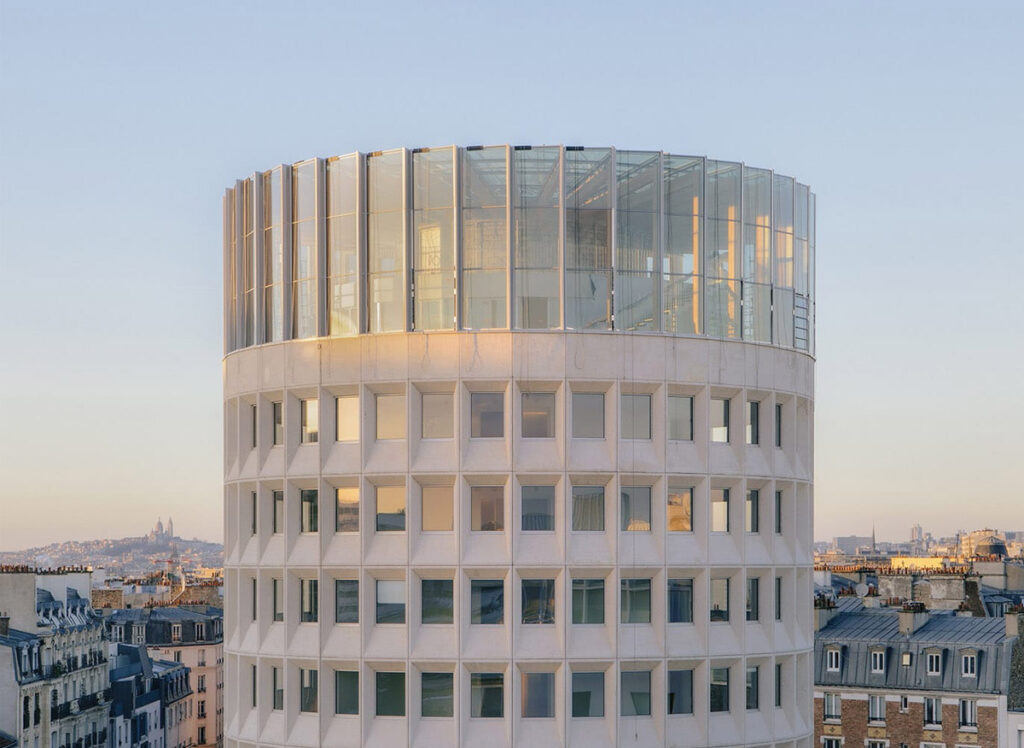
Tour Racine, Paris
Architects: Maud Caubet Architectes
(Facade) engineering & consulting: Arcora and CSD Faces
Photo: Laurent Kronental
Tour Racine in Paris’s 12th arrondissement shows “reduce, reuse, reclad” at tower scale. Originally a 1970s brutalist ONF headquarters, the 35‑metre concrete frame is retained and extended rather than demolished. Maud Caubet Architectes replace the attic with a timber‑frame glass crown housing an urban greenhouse and café, while a fully renewed glazed façade improves daylight and comfort. Facade engineering and building‑enclosure consulting are led by Arcora and CSD Faces, alongside Structureo and ATEC for structure and MEP. The project delivers about 6,081 m² of mixed‑use space and achieves HQE Excellent, Effinergie+ and BiodiverCity certifications, indicating strong energy performance and low‑carbon operation. Delivered in 2024 for Alderan (SCI EWOK), Racine Tower demonstrates how careful diagnostics, structural reuse, and a new high‑performance envelope can transform an obsolete high‑rise into a flexible, future‑proof asset.
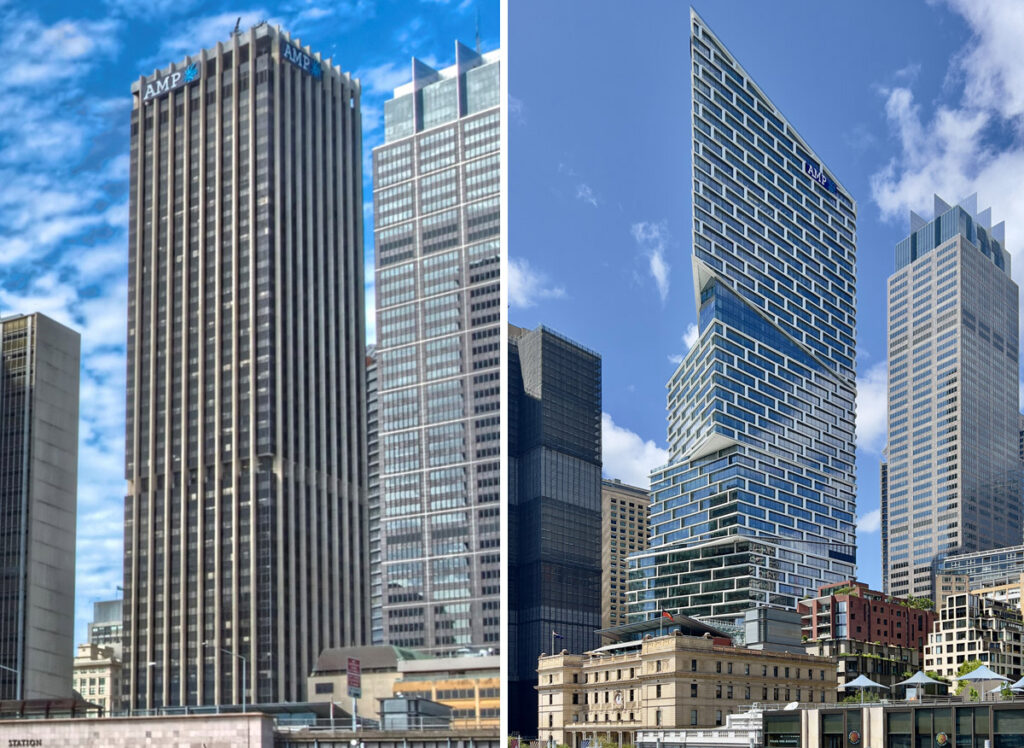
Quay Quarter Tower, Sidney, Australia
Architects: 3XN and BVN
Facade and sustainability engineer: Arup
Photos: Chris Olszewski, Jason Tong
Quay Quarter Tower in Sydney, designed by 3XN with BVN as executive architect and Arup as façade and sustainability engineer, is often described as the world’s first “upcycled” skyscraper. Rather than demolish the 1970s AMP Centre, the team retained about 65% of the original structure and 98% of the core walls, doubling net lettable area while extending the tower’s design life by roughly 50 years. This strategy saved around 12000 tonnes of embodied CO₂ compared to a conventional new build (equivalent to tens of thousands of Sydney–Melbourne flights) and helped the project achieve a 6‑Star Green Star rating.
The new self‑shading, high‑performance curtain wall uses optimised sunshade geometry and selective glazing to cut solar gains, reduce cooling loads, and improve daylight penetration across 2,000 m² floor plates, outperforming many comparable new towers in operational energy use. Completed in 2022, Quay Quarter Tower is a benchmark for the “reduce, reuse, reclad” mindset at high‑rise scale.