


Why static lifecycle thinking falls short once buildings are in use
Real-time façade performance is rarely considered when façade sustainability is defined at the beginning of a project. Materials are selected, embodied carbon is calculated, and performance is modelled under assumptions. These steps are essential: they shape early decisions and define expectations. But façades do not remain static after handover. They face weather, ageing, installation tolerances, maintenance practices and patterns of use. Over time thermal behaviour can drift, seals degrade, and components are repaired or replaced. When this happens, the environmental profile defined at design stage no longer reflects operational reality. This is where a gap appears. Lifecycle assessment is often treated as a fixed output. It describes what the façade was expected to do, not what it does over time. For decision makers this creates a problem: environmental claims may remain unchanged even when performance has shifted.
By Arezou Farshi, MSc Building Engineering, Politecnico di Milano
Real‑Time Façade Performance as the Starting Point
A more reliable approach starts from performance.
Instead of treating LCA as a one‑time result, real‑time façade performance can form the basis of an evolving environmental record. The practical question becomes: is the façade still performing as intended?
If yes, original assumptions hold. If no, consequences extend beyond comfort or energy bills. A persistent performance gap can increase energy demand, accelerate maintenance cycles or prompt premature replacement. Each outcome carries a direct environmental cost. Ignoring these effects means ignoring part of the building’s true lifecycle footprint.
Not every fluctuation matters. Façades naturally respond to changing conditions. When deviations become stable enough to influence operation or maintenance decisions, they become relevant for lifecycle thinking.
Turning Real‑Time Façade Performance into Actionable Insight
For this approach to work, the path from measurement to environmental insight must be simple and usable.
First, establish a baseline for a representative façade element from design values or verified initial measurements. Then use real‑time façade performance data to detect deviations from that baseline. When a deviation persists, translate it into additional energy demand under a defined scenario and convert that penalty into operational carbon using conservative factors. Record repair or replacement events to reflect changes in embodied impact. The outcome is not a theoretical model but a continuously updated environmental record grounded in actual behaviour.
Performance Monitoring Across the Façade
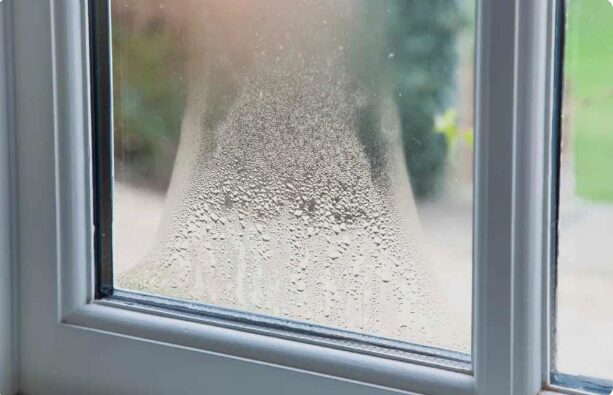
A robust methodology does not require instrumenting entire façade. Monitoring should focus on selected representative panels chosen for exposure conditions and long term relevance. Panels are selected across orientations (South, East, West, North) at different heights, angles, and under comparable internal and external exposure. Rather than relying on a single metric, the strategy records multiple indicators (thermal transmittance, air leakage, surface temperatures, solar gain and moisture trends) so deviations can be interpreted in context. The objective is to identify the most vulnerable points and best representative panel for each exposure category, capturing combined influence of solar load, wind, shading and installation variability while avoiding unnecessary instrumentation. This targeted approach ensures real time façade performance reflects operational reality rather than a single isolated measurement.
Proof of Concept: A Monitored Window in Milan
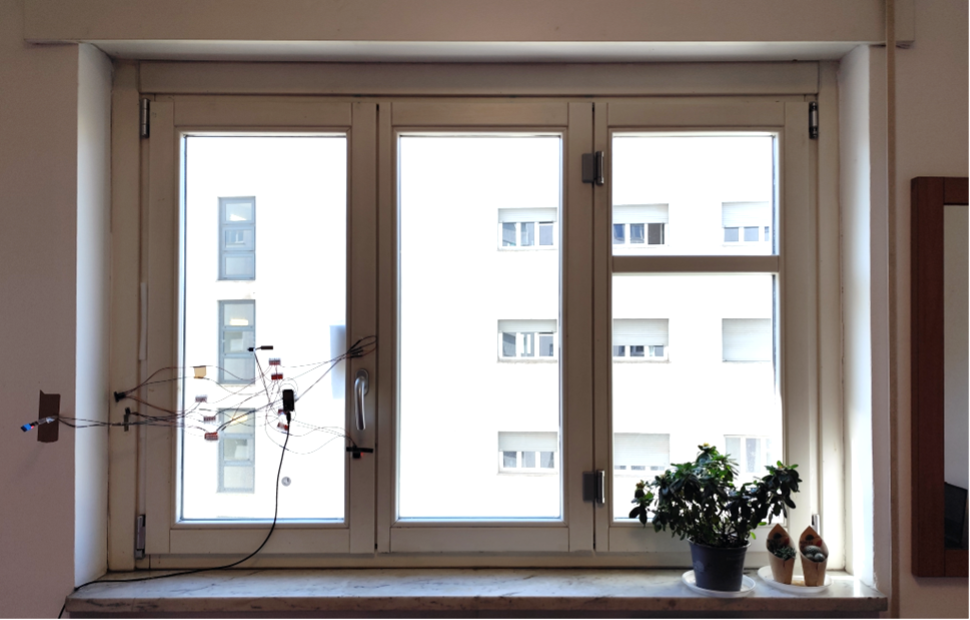
This approach was tested ton a west‑facing window at the Galileo Galilei Residence in Milan using a non‑invasive sensing setup and a lightweight data platform.
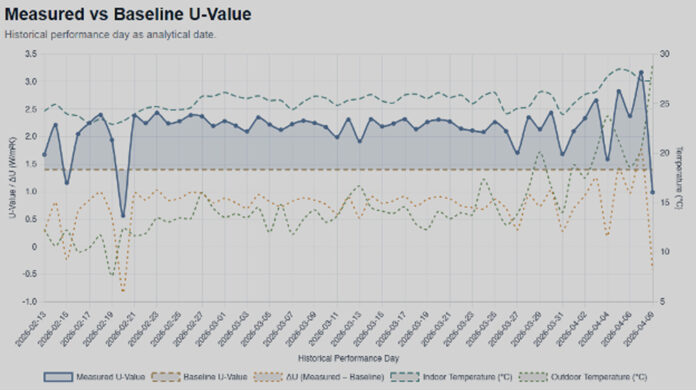
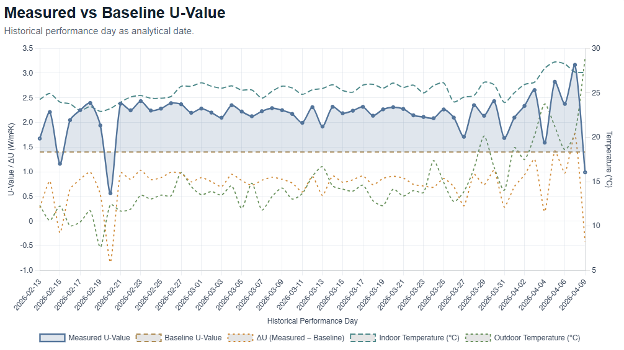
Measured thermal behaviour was compared with the design baseline; the monitored U‑value remained consistently above the expected value, indicating a persistent thermal deviation.
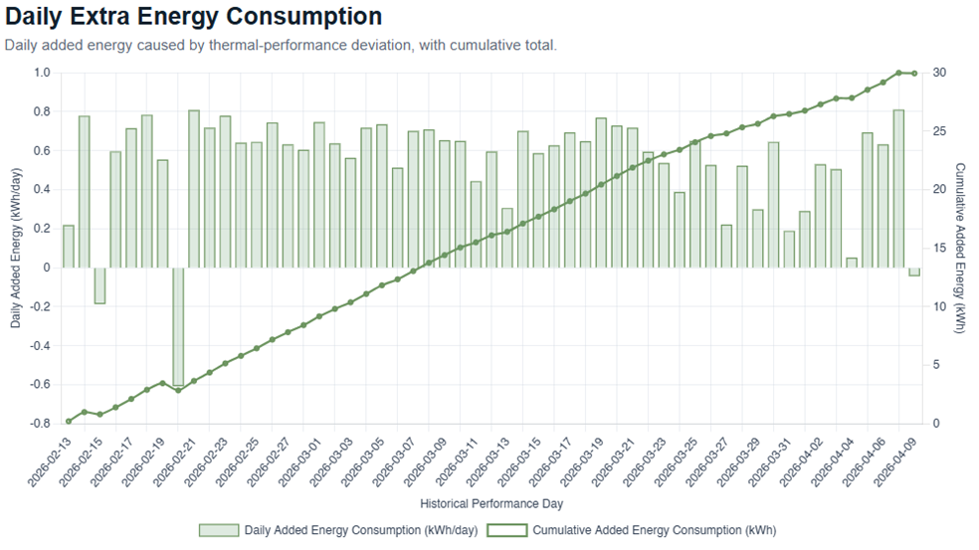
That deviation was translated into additional daily energy demand; while daily values fluctuated, the cumulative trend showed a steady increase in energy use linked to the façade element.
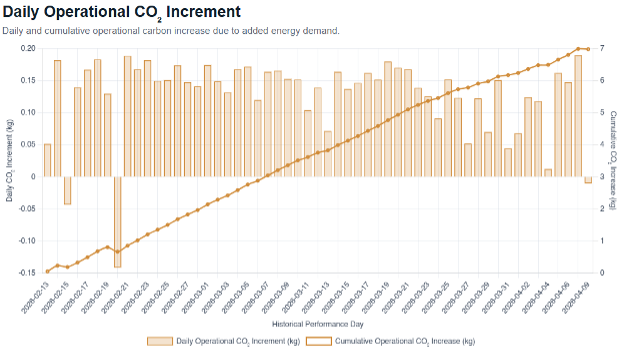
Using a defined emissions factor, the system converted this additional energy into operational CO₂ emmision. The cumulative increase remained moderate, but clearly measurable.
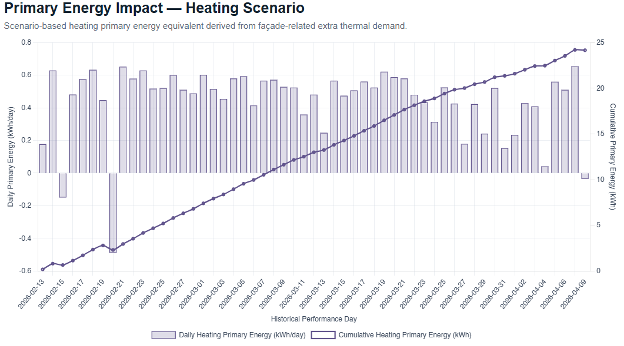
Converting this energy penalty into operational CO₂ produced a measurable cumulative increase. Expressing the same deviation in primary energy terms under a heating scenario allowed energy and carbon impacts to be evaluated together.
The scale of a single window is limited; the significance lies in the method. Measured behaviour becomes the trigger for updating environmental understanding rather than relying solely on initial assumptions. This is how real‑time façade performance moves from observation to decision.
What This Changes for Practice
For façade engineers, architects and owners, this shift is not about adding complexity but about improving continuity between design, operation and decision making. A dynamic LCA supports targeted maintenance by identifying elements that generate the highest operational penalties and enables predictive maintenance so replacements occur before failures escalate. It informs retrofit strategies by highlighting where performance diverges from expectations and can stimulate glazing and façade industries to publish long‑term performance indicators as competitive advantage. If dynamic LCA were adopted in local codes, it would support the durability and environmental reliability of the building stock. For developers and asset managers, environmental performance becomes a verifiable, evolving characteristic of assets rather than a fixed claim.
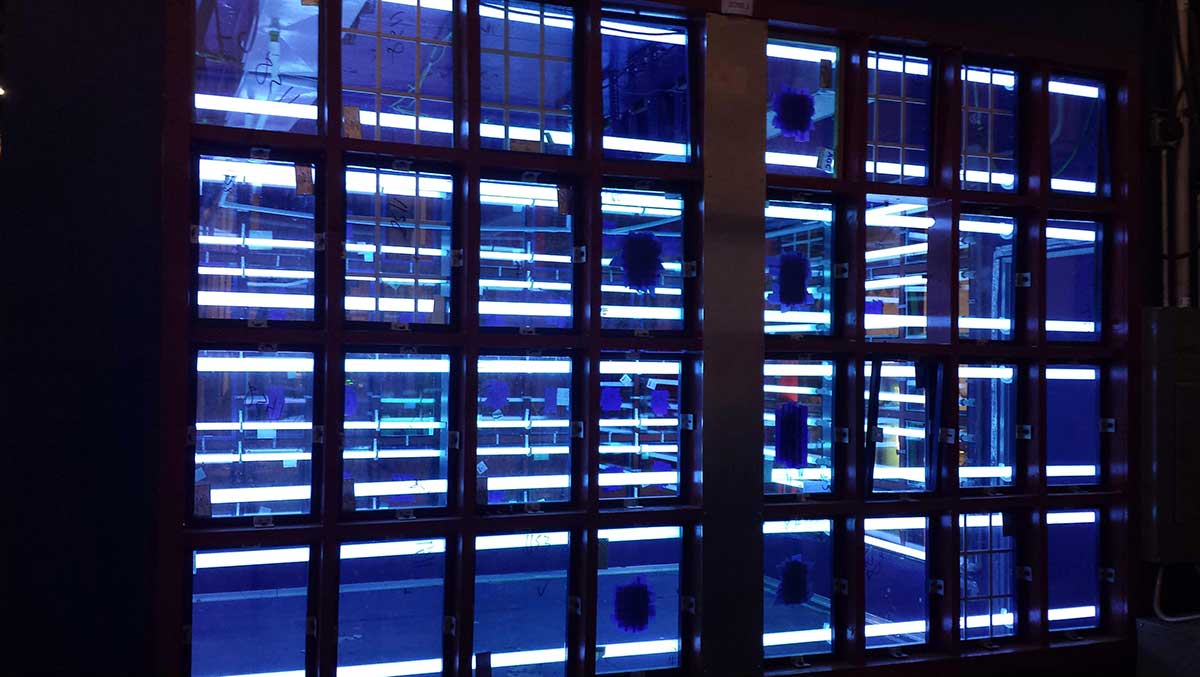
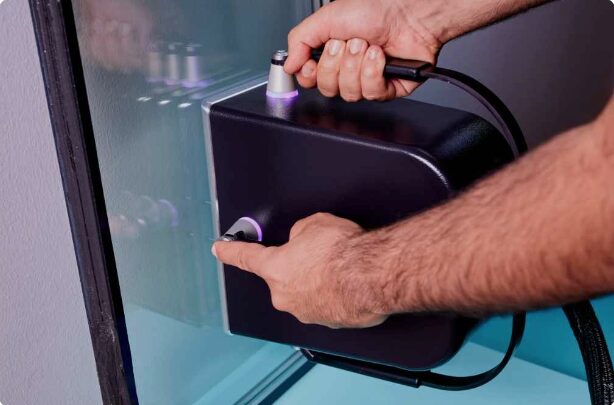
Here is a non-invasive gas measurement device, Sparklike Laser Portable for end-of-line testing. (Photo courtesy of Sparklike)
A Practical Starting Point
The transition to dynamic lifecycle thinking does not require large-scale deployment. A focused pilot on a representative element is enough to establish the workflow. A window, façade module or critical junction can provide meaningful insight when selected under comparable internal and external exposure conditions. Document the baseline, the monitoring strategy and the assumptions used to translate real-time façade performance into environmental impact. As the method matures, additional monitored elements can be added to reflect different orientations or exposure categories, gradually building a broader understanding of façade behaviour across the building.

From Prediction to Verification
Static LCA remains essential during design. It supports material selection and early‑stage comparisons. However, once a building is in use, environmental performance should not remain based on prediction alone. Aligning lifecycle assessment with real‑time façade performance transforms it from a static calculation into a living record, allowing sustainability claims to remain consistent with actual behaviour rather than initial expectations. For the façade industry, this is a shift in mindset: from estimating impact once, to understanding it over time; from assumption to verification.

Arezou Farshi
Arezou Farshi is a façade engineer, registered architect, and construction-tech platform developer. Her work focuses on intelligent building envelope systems and the integration of digital technologies into façade engineering, with particular interest in real-time performance evaluation, Digital Product Passports, and data-driven lifecycle approaches. She is open to collaboration with façade companies, technology partners, and industry stakeholders interested in advancing her three construction-tech platforms, each developed with a validated end-to-end pipeline, toward pilot projects, industrial partnerships, and market applications in the building envelope sector.