

What if insulating glass could retain its performance for longer? What if glass coatings could combine solar control with customised patterns? And what if concrete could deliver greater strength with less material? These questions illustrate how material innovation is reshaping the possibilities of façade engineering. At the Advanced Building Skins Conference & Expo – ABS Bern, five presentations explored technologies that go beyond conventional material properties. From advanced coatings and radiative cooling to memory-steel reinforcement and integrated architectural lighting, each contribution revealed new ways to enhance the performance of building envelopes.
As official media partner of the event, Facade Today is bringing these insights to a wider professional audience through a series of articles covering the conference. Rather than focusing primarily on architectural concepts, this selection looked more closely at the materials, manufacturing processes and functional properties behind the next generation of façade systems.

Insulating glass: designing for longer service life

Insulating glass units (IGUs) are fundamental components of modern building envelopes. Their thermal performance depends on several factors, including the integrity of the edge seal and the retention of insulating gas within the cavity. However, their performance does not necessarily remain constant throughout their service life. Chris Davis from H.B. Fuller addressed this challenge through a presentation on longevity and sustainability considerations for next-generation insulating glass.
His starting point was straightforward: how can the industry make insulating glass perform better for longer?
Current standards, including EN 1279, provide testing methods for assessing the durability and performance of insulating glass units. Yet laboratory testing alone cannot fully capture the conditions experienced by installed products over several decades.
Understanding degradation to improve long-term performance and sustainability
Gas concentration is one important indicator. As insulating gas gradually escapes, the thermal performance of an IGU deteriorates. This raises questions about how actual performance evolves in buildings and how accurately current assumptions reflect real operating conditions.
To investigate this, Davis presented findings from a field survey covering five commercial buildings in London. The study examined 1,116 insulating glass units, measuring their remaining gas concentrations. The results revealed considerable variation, with measured concentrations ranging from approximately 1% to 90%. This highlighted the extent of performance degradation that can occur in installed glazing.
The investigation also considered emissivity measurements, providing additional information about the condition and performance of the glass coatings. Together, these measurements offered a more comprehensive picture of IGU degradation.
These findings have implications beyond the replacement of individual units. They also influence how designers and building owners assess the environmental performance of façades throughout their operational life.
Davis discussed the development of a Dynamic Carbon Modelling Project incorporating assumptions about IGU degradation. The objective is to better understand how declining thermal performance affects the carbon footprint of buildings over time. This is particularly relevant when considering heating and cooling requirements. As insulating glass loses performance, buildings may require more energy to maintain comfortable indoor conditions.
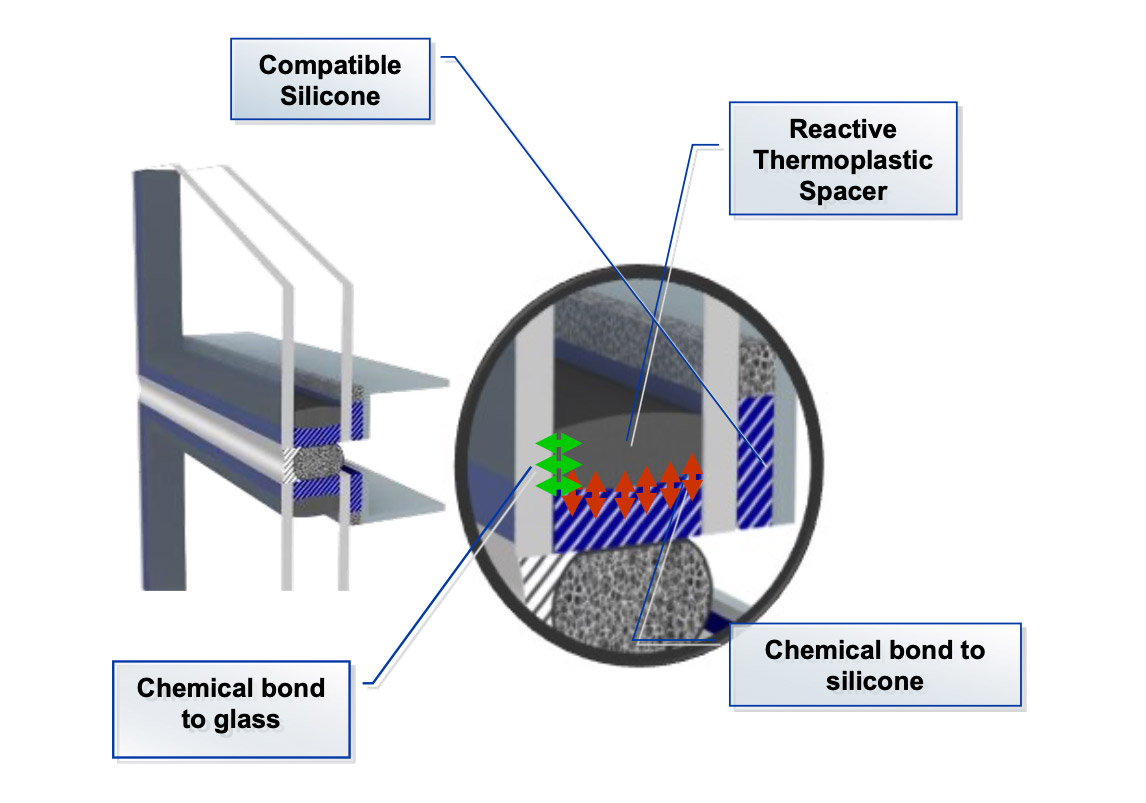
One promising response lies in improved bonding technologies. Davis highlighted H.B. Fuller’s fusion bonding technology as a pathway towards more robust IGU systems.
The approach combines long-term performance considerations with robotic application processes. Greater manufacturing consistency and improved durability could help extend the service life of insulating glass.
Ultimately, the discussion challenged the industry to look beyond initial product specifications. The sustainability of an insulating glass unit depends not only on its performance when installed, but also on how well it maintains that performance over decades.
Advanced glass coatings: new possibilities for façade surfaces

Glass coatings have transformed the performance of architectural façades. Low-emissivity and solar-control coatings, for example, help regulate heat transfer and solar radiation while preserving transparency. But what if coatings could also introduce customised patterns and visual functions without compromising the underlying performance of the glass?
Marcus Frank from Bühler explored this possibility through high-performance free-form coatings for architectural glass façades. His presentation focused on technologies developed by Leybold Optics, Bühler’s business unit specialising in coating equipment for architectural glass. The proposed approach combines printing technologies with physical vapour deposition (PVD). It enables manufacturers to create large-area patterned coatings with carefully controlled geometries.
The process begins with a masking operation. Patterns are applied to the glass using either conventional screen printing or digital printing technologies. The glass then undergoes a heating stage before entering the PVD coating process. During deposition, the coating material is applied to the exposed areas of the surface. Finally, the masking material is washed away, leaving a patterned coating on the glass.
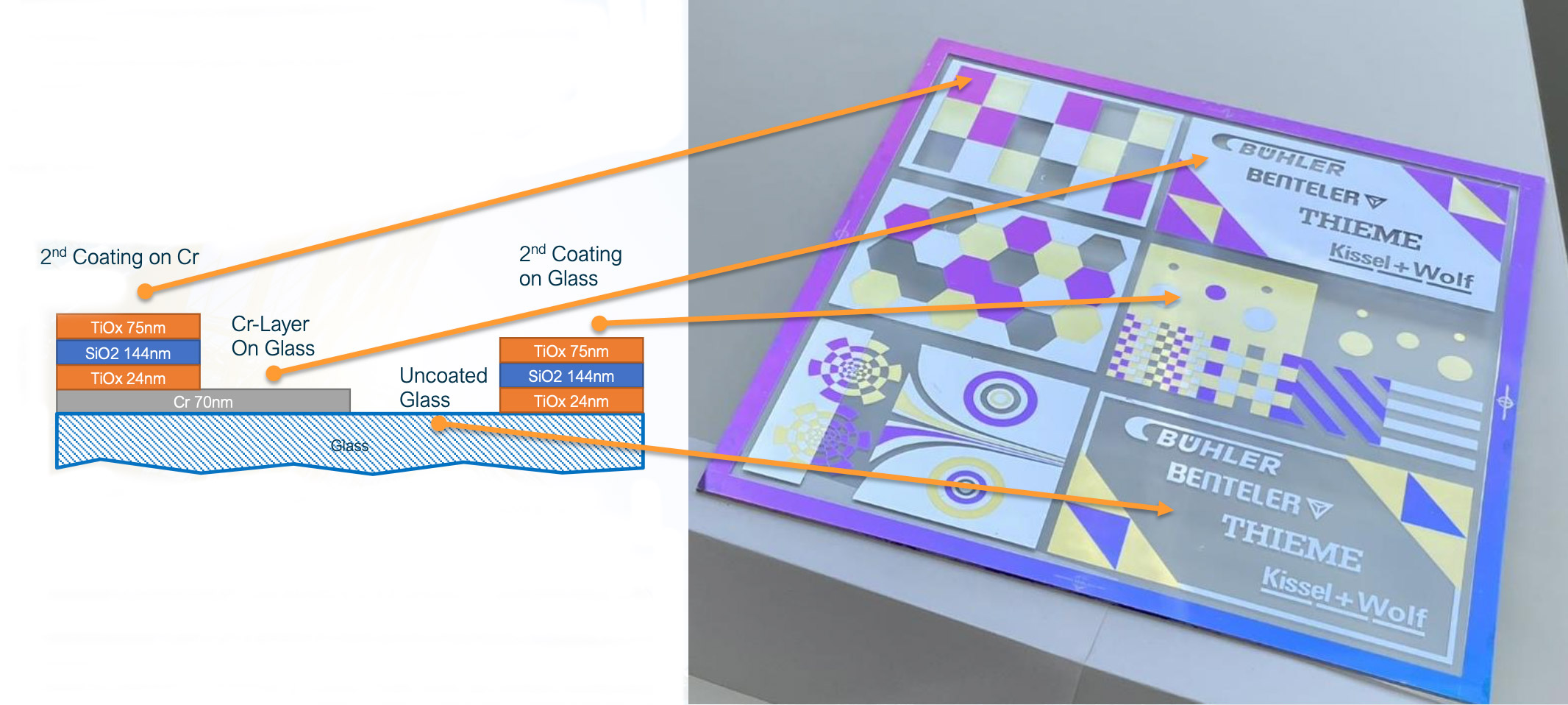
This lift-off process offers an alternative to conventional coating approaches. It allows manufacturers to combine functional surface treatments with greater freedom in the design of glass façades.
Combining functional coatings with large-scale customised patterns
One particularly interesting application concerns bird-friendly glazing. Patterned surfaces can make glass more visible to birds, helping reduce collisions. The patterns can be designed to remain visible from outside while having limited visual impact for occupants inside the building.
Another possibility involves integrating graphics directly into architectural glazing. Corporate logos, decorative patterns and other visual elements could become part of the glass surface itself. This opens new opportunities for architects and façade designers. Instead of adding decorative elements after manufacturing, visual identity could be integrated into the coating process.
The technology illustrates how advances in coating equipment and printing methods can bring together several functions within a single glass component. Glass is no longer simply a transparent building material with a protective coating. Its surface can become an engineered interface combining solar performance, environmental functionality, and visual communication.
Radiative cooling: adding thermal functionality through colour

Colour and thermal performance have traditionally presented a challenge for building envelopes. Dark surfaces absorb more solar radiation and tend to heat up. Lighter surfaces generally reflect more sunlight, helping reduce solar heat gain.
But can coloured surfaces also deliver effective passive cooling?
Kaixin Lin from City University of Hong Kong presented research into coloured fluorescent coatings designed for passive radiative cooling (PRC) of building envelopes.
The underlying principle is to modify the thermal balance between a material and its surroundings. By managing how surfaces absorb, reflect and emit energy, it becomes possible to lower their temperature without mechanical cooling. Passive radiative cooling technologies aim to enhance the thermal emission of surfaces while limiting the amount of solar energy they absorb. For building applications, this requires careful control of the material’s optical properties.
Using fluorescent coatings to combine colour, solar reflectance and passive cooling
Lin’s research explores fluorescence as a way to introduce colour without sacrificing the cooling potential of the coating. The concept draws inspiration from natural systems, including corals. These organisms use fluorescent compounds to produce vivid colours under sunlight.

The research translates this principle into engineered coatings. Under sunlight, a red fluorescent material reflects red light, producing its visible colour. Fluorescence adds another mechanism: absorbed light is subsequently re-emitted at a different wavelength.
The challenge is to maintain high overall solar reflectance while achieving the desired colour effect. To address this, the research uses a bilayer architecture designed to maximise solar reflectance. This structure helps limit solar absorption while preserving the optical properties needed to produce colour. The objective is to develop surfaces that combine aesthetic freedom with passive thermal management.
The technology has already been explored through practical demonstrations. These include applications at the Coliseum in Hong Kong and on the rooftops of private houses.
The research also looks towards broader material applications. Potential substrates include metals, polymers and textiles, extending the technology beyond conventional building coatings.
For façade designers, this could be particularly interesting. Coloured surfaces could contribute to thermal performance rather than simply determining the appearance of the building. If successfully developed at scale, fluorescent radiative cooling coatings could offer another tool for reducing solar heat gain while preserving architectural freedom.
Memory steel: making concrete elements slimmer and stronger

Concrete remains one of the most widely used materials in construction. Yet its mechanical behaviour presents a familiar challenge: while it performs well under compression, it is considerably weaker under tension.
Under demanding loads, concrete can crack and deform. Conventional reinforcement helps address this limitation, but often requires substantial quantities of material.
Daniel Schmidig from re-fer presented an alternative approach using memory-steel reinforcement. His presentation focused particularly on renovation and retrofit applications. The underlying question was simple: what if concrete could do more with less?
Memory steel offers an interesting answer. The material has shape-memory properties that allow it to recover its original geometry when activated by heat. The reinforcement is available in different diameters, including 10 mm and 16 mm bars. It can be embedded in concrete or mortar to introduce prestressing forces.
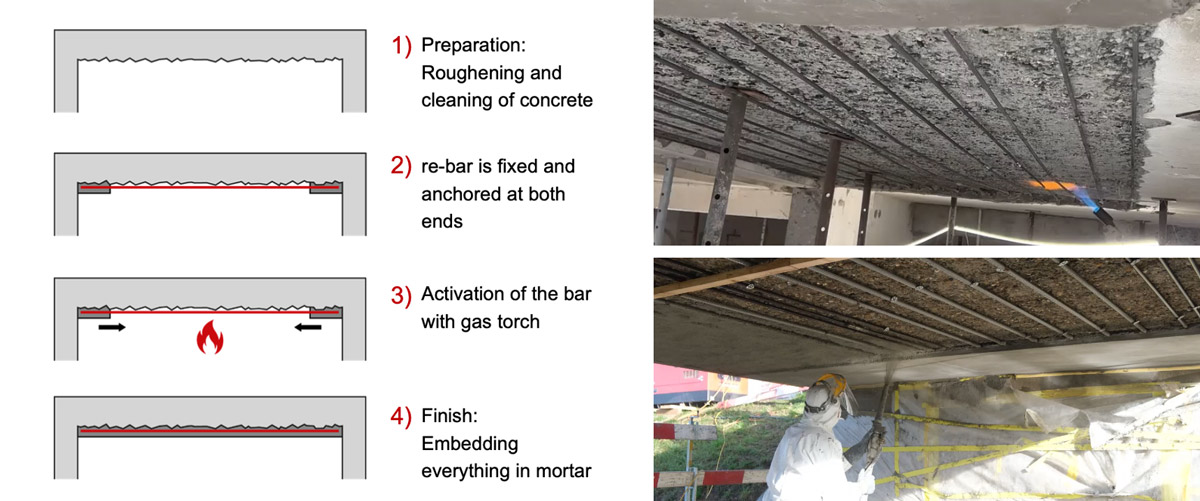
The installation process involves several steps.
First, the steel bars are mechanically elongated during manufacturing. They are then installed in the structure and fixed in position.
Once the reinforcement is heated, it attempts to return to its original shape. This contraction generates tension within the steel, transferring compressive forces to the surrounding concrete.
Harnessing shape-memory reinforcement to reduce material use and improve structural performance
This mechanism can significantly improve the structural behaviour of concrete elements. It helps control cracking, reduce deformation and achieve higher performance with less material. Schmidig illustrated the technology through several renovation applications. Another application concerns historic buildings. The reinforcement can help pull existing cracks together, improving structural integrity without requiring extensive demolition. The technology can also address situations where corrosion has weakened the outer concrete layer. A new mortar layer incorporating memory-steel reinforcement can help restore structural performance.
These applications can reduce material consumption and associated CO₂ emissions. They also avoid demolition and allow buildings to remain in continuous use during the intervention. This last point is particularly important for industrial facilities and other buildings where operational interruptions are costly.
The technology is also opening new research opportunities. Current investigations include alternative wire configurations, free-form applications and compatibility with 3D printing processes.
For façade engineering, the potential is significant. Slimmer concrete elements could help reduce the weight of building envelope systems while maintaining demanding structural requirements. More broadly, memory steel illustrates how advanced reinforcement technologies can extend the possibilities of conventional construction materials.
Architectural lighting: integrating the fifth façade function

A building has two identities: one during daylight and another after dark. Vladimir Grigorik from GVA Lighting explored this idea in his presentation on façade-integrated media façades and architectural lighting. Quoting Frank Lloyd Wright, he reminded the audience that “Light is the beautifier of the building.”
Architectural lighting has long been used to emphasise building forms, highlight structural features and create distinctive nighttime identities. However, lighting systems are often treated as additional equipment. They are designed and installed after the main façade components have already been developed.
Making lighting an integral part of façade design and construction
Grigorik presented a different approach: integrating lighting into the façade system from the outset. His examples demonstrated how lighting can become an integral part of architectural expression. The presentation included projects such as Block 185, the Deloitte building in Montreal, the Figge Museum and 270 Park Avenue in New York.
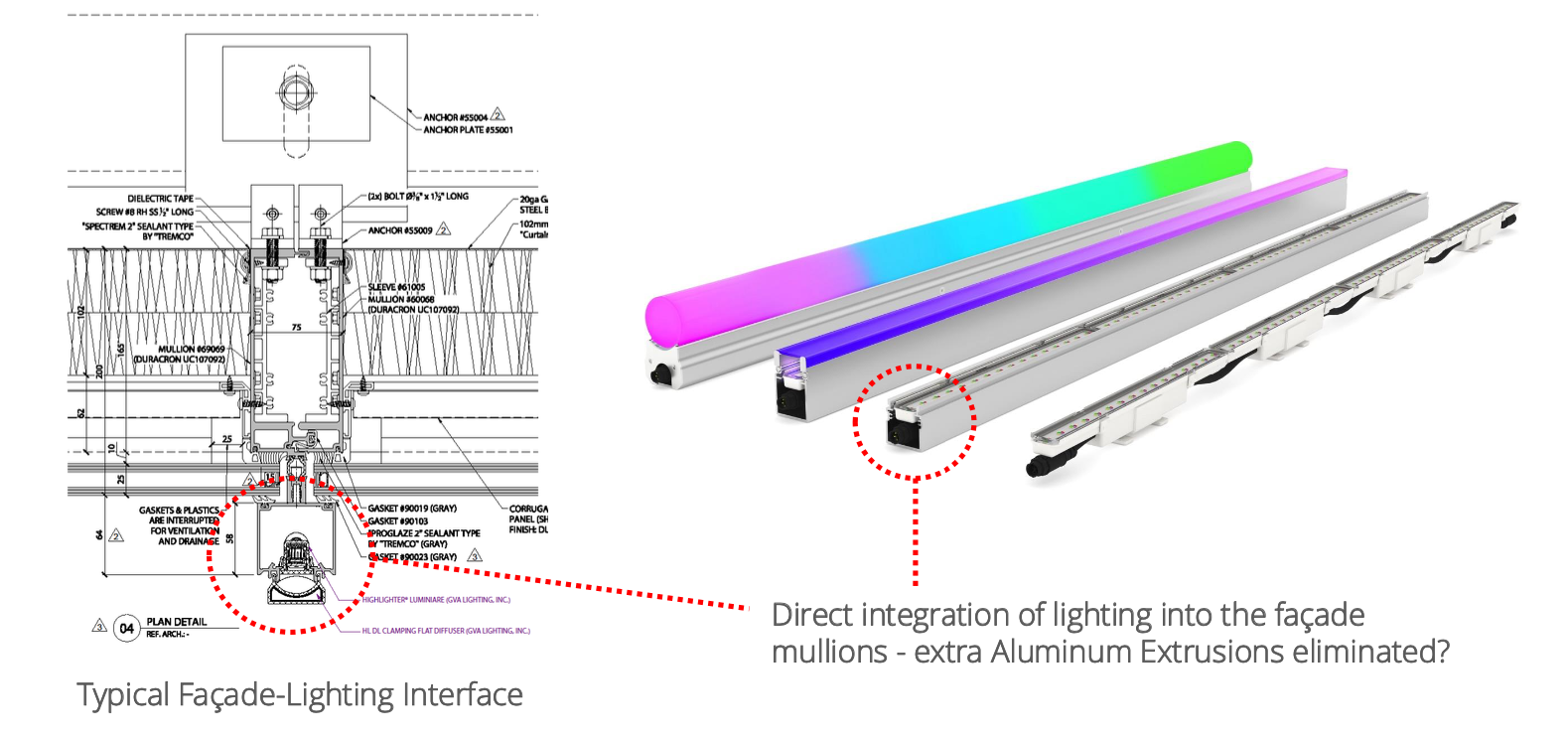
One particularly interesting product feature involved integrating the lighting rail directly into the aluminium frame. Rather than attaching a lighting element to the completed façade, the system makes it part of the architectural assembly itself. This approach has several potential advantages. It creates a more coherent relationship between the façade and its lighting system, while reducing the need for additional visible components. It also encourages closer collaboration between architects, façade consultants, system manufacturers and lighting specialists during the design process.
Yet successful integration requires more than selecting appropriate lighting equipment. The system must respond to the architectural geometry, materials and detailing of the façade.
It must also be considered alongside installation, maintenance and long-term operational requirements. For façade designers, this means treating lighting as part of the building envelope strategy rather than as a separate decorative layer. The boundary between façade construction and architectural lighting is becoming increasingly fluid. This creates new opportunities to rethink how buildings communicate with their surroundings.
Conclusion: From material properties to new façade functions
The five presentations at ABS Bern demonstrated how innovation is changing the role of materials within the building envelope.
Some developments seek to improve the durability of established products. Others introduce entirely new functional properties or rethink how conventional materials are manufactured and assembled.
Despite their differences, these technologies share an important characteristic. They move beyond the traditional understanding of façade materials as passive components. Glass, concrete, coatings and aluminium framing can increasingly perform several functions simultaneously. Their properties can be engineered, combined and adapted to specific environmental and architectural requirements. This evolution also places greater emphasis on collaboration between material scientists, manufacturers, façade engineers and architects.
The next generation of building envelopes will not necessarily rely on entirely new materials. It may instead emerge from discovering what existing materials can achieve when their properties and manufacturing processes are reconsidered. That is perhaps the most interesting message from ABS Bern: the future of façade innovation starts at the material level.
Beyond the conference
ABS Bern 2026 offered a valuable forum to explore the transition from promising technologies to coordinated, buildable and lasting envelope solutions. As a media partner of major façade events, Facade Today is committed to bringing these discussions to a wider professional audience. Through interviews with industry professionals and in-depth editorial coverage, we connect innovation, expertise and knowledge with architects and façade engineering practices, encouraging exchange between research, industry and design.
For façade professionals, ABS Bern was more than a conference. The exhibition provided a parallel setting for discussions with suppliers and technology developers. The programme brought together companies and organisations including NorthGlass, Pellini, Bühler, Swisspearl, Lanik, Fraunhofer, Solarix, Metsolar and Kömmerling, among others.
For more information and the practical details:
https://abs.green/home
Are you organizing an event related to façade design, smart materials, sustainable construction, or architectural innovation?
Let’s talk! We’re always open to media partnerships that align with our editorial mission and bring value to our readers.
Reach out to us at editor@facadetoday.com
We’d love to hear about your event.