

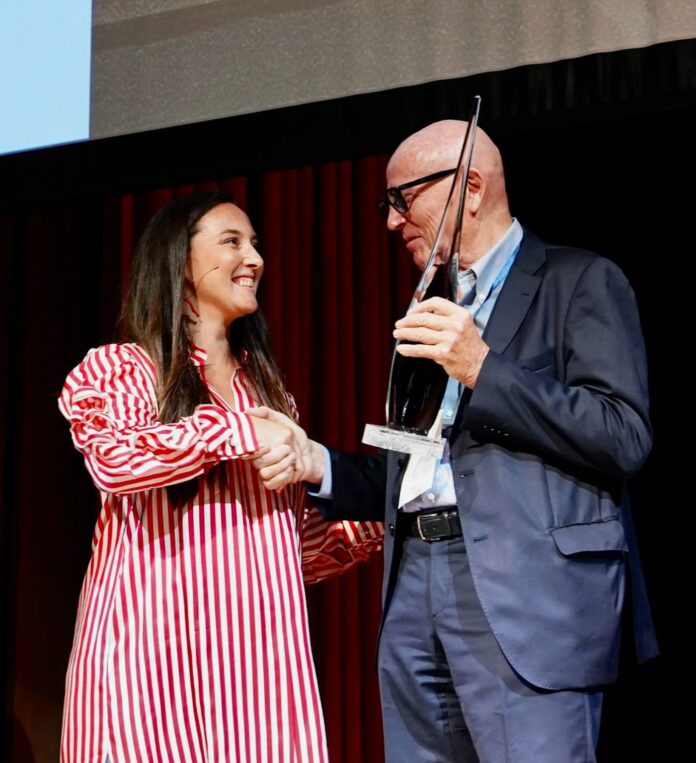
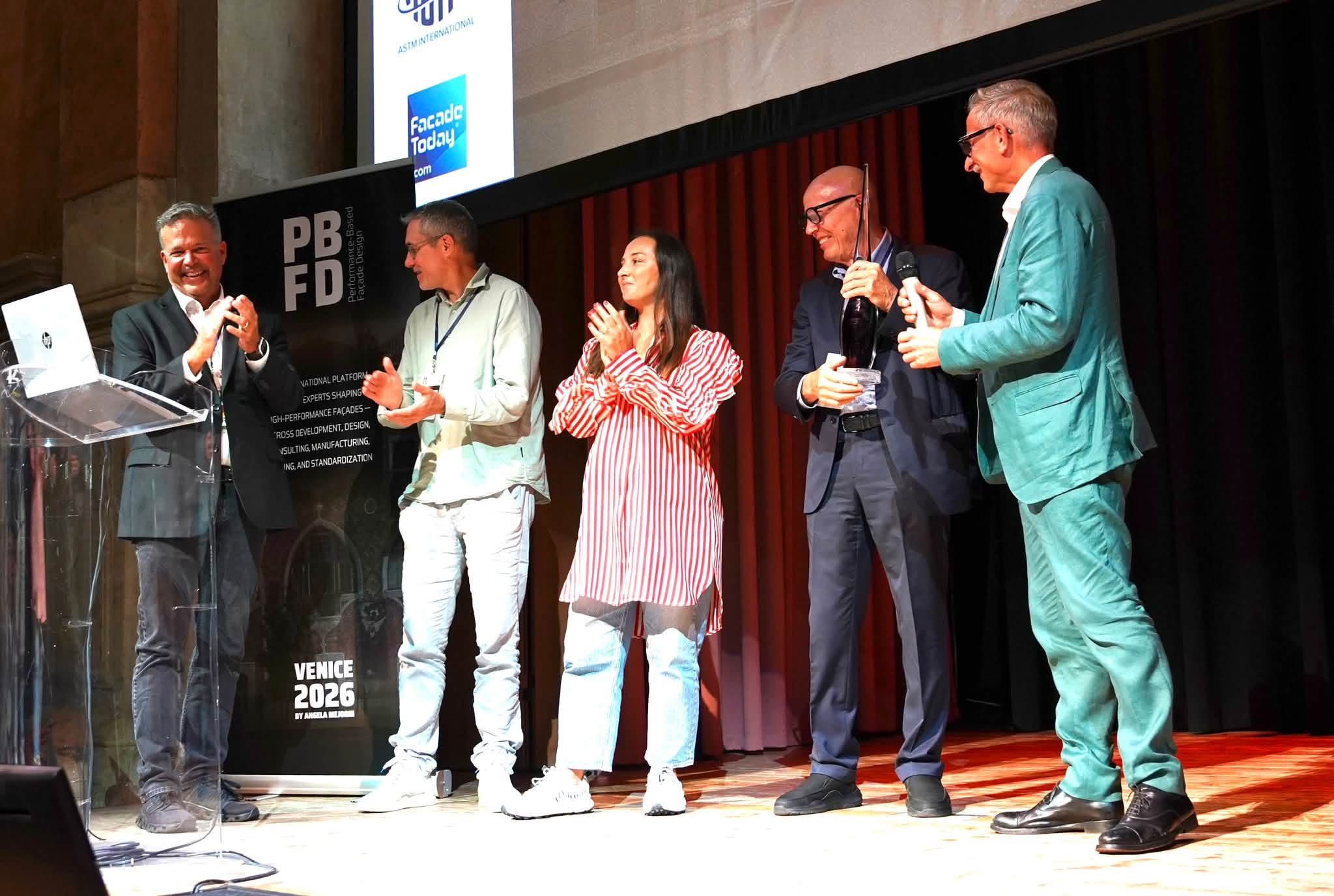
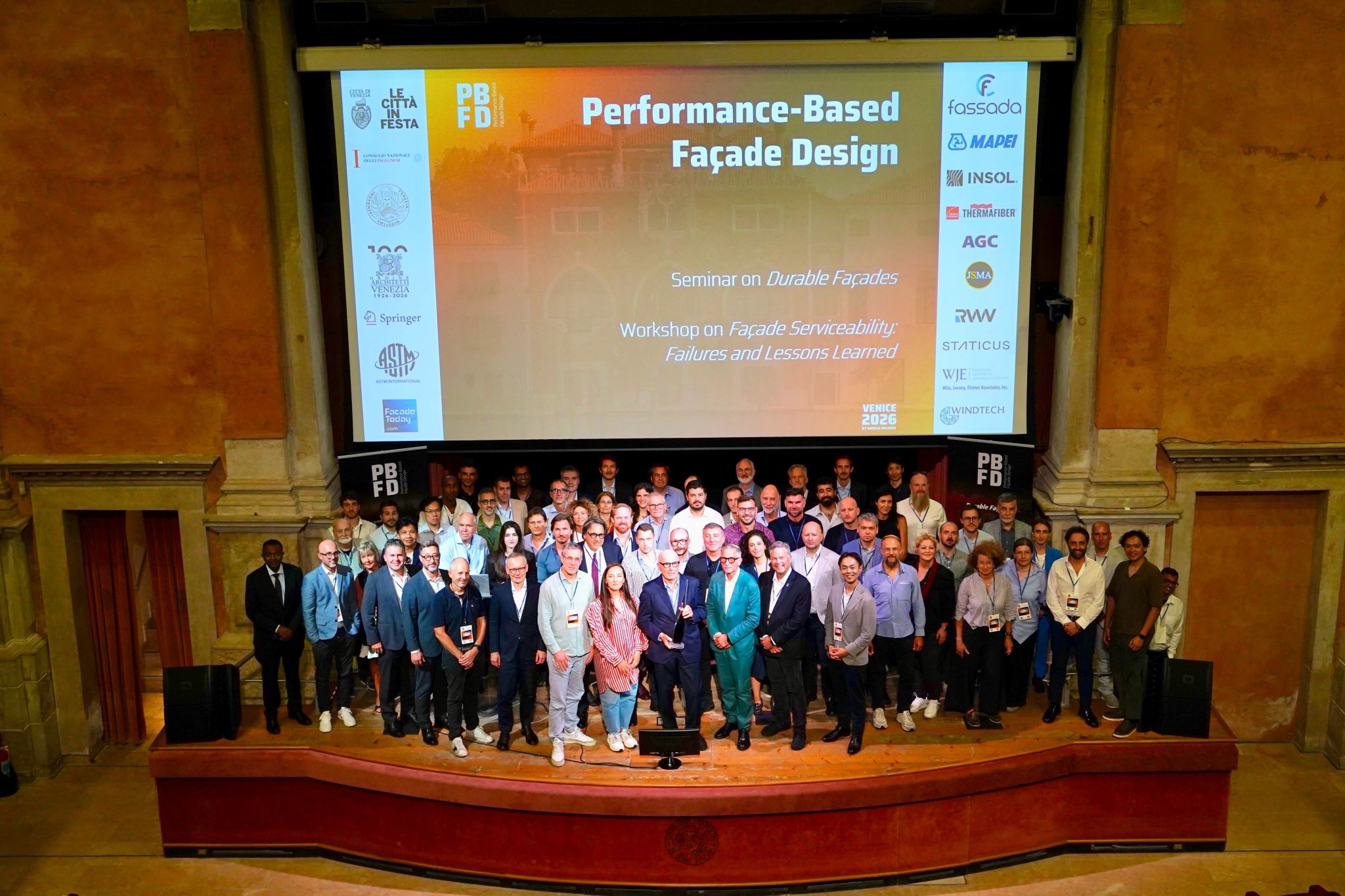
At the 2026 edition of Performance-Based Façade Design (PBFD) in Venice, Massimo Colomban received the PBFD Career Recognition, honouring a lifetime of influence on the international façade industry. The award acknowledged more than the growth of a single company: it recognised a professional legacy that helped reshape how complex architectural envelopes are conceived, engineered, manufactured and delivered around the world.
For the first article in Facade Today’s PBFD 2026 coverage, the focus turns to Massimo Colomban’s remarkable journey, from a young worker in the Veneto window industry to founder and long-time leader of Permasteelisa, the group that became synonymous with the delivery of ambitious, highly engineered building envelopes. His career offers a useful lens through which to consider several enduring questions for the sector: how façade specialists translate architectural ambition into buildable reality; how technical expertise can scale internationally; and why people, partnerships and continuous innovation remain decisive in a project-based industry.
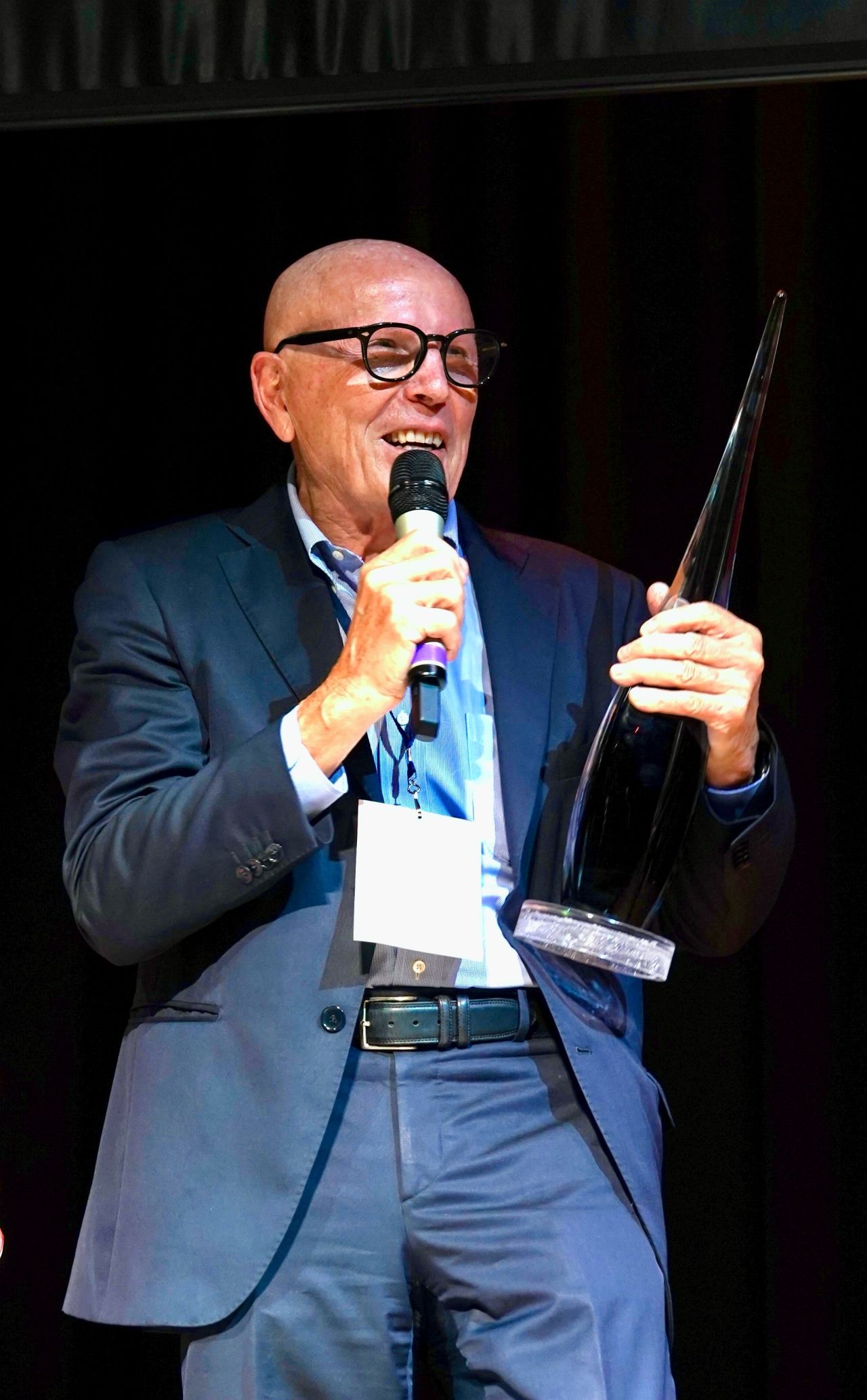
During the conference, Massimo Colomban’s recognition stood alongside PBFD’s wider theme of durable façades. It was an appropriate setting for a figure whose work has been associated with the evolution of façade engineering over several decades, across changing architectural languages, increasingly complex geometries, industrialised production and growing expectations for environmental and operational performance.
In the interview below, Massimo Colomban reflects on the growth of Permasteelisa, the practical meaning of innovation in building envelopes, the importance of operating locally within global markets, and the leadership principle that has guided him throughout his career: “Our minds are larger than mine.”
Massimo Colomban: a global façade legacy
Massimo Colomban’s story begins not in a boardroom, but on the factory floor. At the age of 14, he began working in the Italian window and envelope sector while continuing his education through evening study. He later attended IUAV University in Venice before founding ISA (Industria Serramenti in Alluminio) in 1973, the company that would form the basis of the future Permasteelisa Group.
What distinguished Massimo Colomban’s approach was an early understanding that façades are neither a simple construction product nor a purely architectural expression. They are a meeting point of design, engineering, manufacturing and installation. For major projects, success depends on bringing those disciplines together in a coordinated way: translating an architect’s intention into a technically robust system, producing it efficiently and installing it precisely under demanding site conditions.
Under Massimo Colomban’s leadership, ISA expanded well beyond its Veneto origins. A key step was the international development of the company, including its relationship with the Australian firm Permasteel Industries, known for delivering the glass cladding of the Sydney Opera House. This helped establish the Permasteelisa name and marked a decisive shift towards a global façade-engineering organisation.
By the time Massimo Colomban left the group in 2002, Permasteelisa had developed into an international network of around 40 companies operating across four continents. The group had annual revenues of more than €1 billion and employed approximately 5,000 people directly, supported by a wider supply chain. Its growth reflected a model that combined local market knowledge with shared technical capability, investment in advanced production processes and the development of specialist teams capable of delivering one-off, architecturally demanding projects.
Massimo Colomban’s influence is therefore closely connected to the modernisation and internationalisation of the façade sector. Permasteelisa became associated with the kind of highly customised envelopes often required by landmark architecture: projects where the façade contractor must operate as an engineering partner rather than simply as a supplier. The company’s global presence also demonstrated how specialist façade knowledge could be transferred between markets while remaining grounded in local expertise and delivery capacity.
At PBFD 2026, the Career Recognition celebrated this wider contribution: a career that helped demonstrate the façade’s central role in architecture, construction performance and technological innovation.
Interview with Massimo Colomban
Founder and Honorary President of Permasteelisa
Facade Today: Massimo Colomban, you have been working in the industry for more than 60 years. During the first ten of those years, from the age of 14 to 24, you combined work with your studies in engineering and architecture at IUAV University in Venice.
In your recent book, Shaping Wonders, which features a foreword by Frank Gehry and personal dedications from Richard Rogers and Renzo Piano, you describe the journey that took you from the small company ISA to Permasteelisa, which became, in just 25 years, one of the world’s leading and most highly regarded companies in the field of façades and building envelopes.
When you left the company in 2002, the Group had annual revenues of more than one billion euros, approximately 5,000 direct employees and another 3,000 people working across its supply chain, with 40 companies operating on four continents.
How did you achieve all this?
Massimo Colombani: From an early age, I worked for an Italian company specializing in windows, façades and building envelopes. I was curious, ambitious and fortunate enough to take on increasingly responsible roles: first in the factory and on installation sites, and later in the technical office as a designer and Project Manager. By working and studying simultaneously, I developed the professional skills and practical experience that enabled me to become an entrepreneur at just 24.
But I had ambitions for growth and, above all, for international expansion. That is why, from the very beginning, I chose a strategy based on partnerships, bringing together outstanding technicians and managers and building alliances with companies whose capabilities could complement and reinforce our own.
Our industry, the Building Envelope sector, rests on three closely interconnected pillars: Engineering, Manufacturing and Installation. Engineering must transform an architect’s vision and design solutions into a product that is technically sound, functionally viable and capable of being built.
Manufacturing must then engineer that product for efficient production, increasingly through automated manufacturing lines.
Finally, Installation must work in close coordination with Engineering to optimize logistics, installation sequences and construction schedules.
At Permasteelisa, we brought these three disciplines together to develop increasingly innovative products, not only in terms of technical performance, but, above all, in terms of production efficiency, both in the factory and on site. We achieved this through extensive mechanization and, wherever possible, robotics. The key people driving this process were motivated and rewarded according to the quality and precision of their work and, above all, according to the economic results they achieved. We used incentive systems and, in some cases, stock options.
As we expanded internationally, we replicated the same philosophy by training, empowering and giving responsibility to local people. Each company within the network could therefore develop with a high degree of autonomy, while simultaneously benefiting from the expertise, technologies and innovations developed throughout the Group.
The companies in our network had shared access to product and process innovations, the design of automated and robotic production lines, software, technical expertise, financial resources, marketing, insurance and international references. At one point, for example, we were able to offer a 10-year comprehensive warranty on our projects.
As the Group expanded, our international track record became increasingly valuable, creating an additional competitive advantage for every company within the network. In essence, this was the formula that enabled me, in just over twenty years, to build 40 strong and profitable companies across four continents, transforming an Italian company into a global technology leader in the building-envelope industry.
You describe innovation as an absolute necessity. What does innovation actually mean, in practical terms, for a company operating in the façade industry?
To me, innovation, when it is sustainable, constant and continuous, is the essential condition for remaining competitive. It is a condition for staying alive, for continuing to exist. Anything that stands still will, sooner or later, deteriorate and die.
In the building-envelope industry, innovation first and foremost means knowing how to reconcile form and function. Form, aesthetics, architecture and the impact of buildings on the surrounding landscape have changed dramatically over the decades, driven in large part by advances in technology and materials. We have moved from predominantly geometric forms towards increasingly complex, fluid and dynamic solutions. Think of the Sydney Opera House, the Guggenheim Museum in Bilbao and the many extraordinary buildings designed by Frank Gehry.
But form must never take precedence over function, and certainly must never cause us to overlook the fundamental role that a building envelope is required to perform. Whether opaque or transparent, the façade must separate and protect the interior environment from external conditions, including the most extreme: heat, solar radiation, wind, storms, hurricanes, hail, seismic events, cold and freezing temperatures.
It must provide thermal insulation in both summer and winter, helping to reduce energy consumption and, ideally, enabling us to design building envelopes with near-zero energy consumption. It must also protect against dust, pollution and corrosion, while ensuring long-term durability and occupant comfort.
But there is another step that I consider fundamental:
The building envelope should not be static. It should be interactive. External conditions are constantly changing. Ideally, the building envelope should therefore be capable of responding and adapting to changing climatic conditions. At Permasteelisa, during the years when I was leading the Group, we developed what we called Blue Technologies: façades capable of capturing and utilizing solar radiation during the winter and rejecting it during the summer.
At the time, these technologies were still pioneering, but we successfully applied them to a number of buildings. I believe this remains one of the great frontiers of our industry. Technology will continue to evolve, and whoever succeeds in addressing these challenges in a way that is economically viable, efficient and, above all, replicable will have the opportunity to become a leader in the markets of the future.
How important were partnerships in building trust internationally?
The principle I adopted from the very beginning, when we entered international markets in 1974, was very simple: “Think Global, but Act Local.”
You cannot operate effectively in markets that differ fundamentally in language, culture, legislation, regulations and business practices unless you have people and partners who understand those markets from the inside.
Companies operating in Curtain Walls, Façades and, more accurately, Building Envelopes need managers, partners and key people who have a deep understanding of the environment in which they operate. That is why, from the earliest stages of our international expansion, we pursued a dual strategy. On the one hand, we established partnerships with local companies whose capabilities were complementary to ours and which were willing to build long-term alliances. On the other, whenever such partnerships were not possible, we established local companies ourselves, involving local managers and potential future partners from the outset. International trust cannot be built simply by exporting a product. It is built by sharing expertise, responsibility and interests with people who understand the territory and the market in which you want to grow.
What is the most important leadership lesson you learned throughout your career, and one that, in your view, young entrepreneurs in the façade industry tend to underestimate?
The first thing they need to understand is that we, as façade manufacturers and building-envelope specialists, are not like automobile manufacturers, computer companies or mass-market consumer-goods producers.
In those industries, the product is generally repetitive: it is manufactured thousands or millions of times, and research, automation, robotics and brand marketing can play a greater role than individual human expertise.
Our industry is fundamentally different. The product is almost never repetitive. On the contrary, it is often unique, innovative and highly customized, depending on the architect, the investor and the specific requirements of each project. That is why our technicians, designers and construction professionals, both in the factory and on site, must be experienced, creative and highly skilled. It is no coincidence that some newspapers have described us as “the haute couture tailors of architecture.”
So, the most important leadership lesson I have learned is this: An entrepreneur cannot succeed alone for very long. You need to build a network of highly competent people, motivate them, give them responsibility and recognize the value they bring. This applies not only to technicians and managers, but also to partners and to the companies that become part of the network.
My motto has always been: “Our minds are larger than mine.”
I believe this perfectly captures the essence of genuine teamwork: The collective intelligence and expertise of a group are always greater than those of any single individual.
The conference
PBFD 2026 in Venice placed durable façades at the heart of the industry conversation, arguing that long-term performance must be designed into the envelope from the earliest concept stage, not considered only after handover or when problems emerge.
The key message was that durability is not simply a question of choosing robust materials. It depends on the full lifecycle of the façade: intelligent design, accurate engineering, suitable testing, controlled fabrication and installation, practical access for inspection and maintenance, and clear information for the building owner over time.
A strong focus was also placed on serviceability. The dedicated workshop on Façade Serviceability: Failures and Lessons Learned explored real operating conditions, documented failures, diagnostic methods, test protocols and remediation strategies. Its underlying lesson is straightforward: the sector must learn systematically from defects and underperformance, translating evidence into better specifications, detailing, testing and asset-management practice.
PBFD 2026 ultimately reinforced that durable façades are a shared responsibility among architects, consultants, contractors, manufacturers, developers and owners. As Media Partner of Performance-Based Façade Design 2026, Facade Today will continue to report on the ideas, people and project lessons that emerged from this year’s conference.
Are you organizing an event related to façade design, smart materials, sustainable construction, or architectural innovation?
Let’s talk! We’re always open to media partnerships that align with our editorial mission and bring value to our readers.
Reach out to us at editor@facadetoday.com
We’d love to hear about your event.